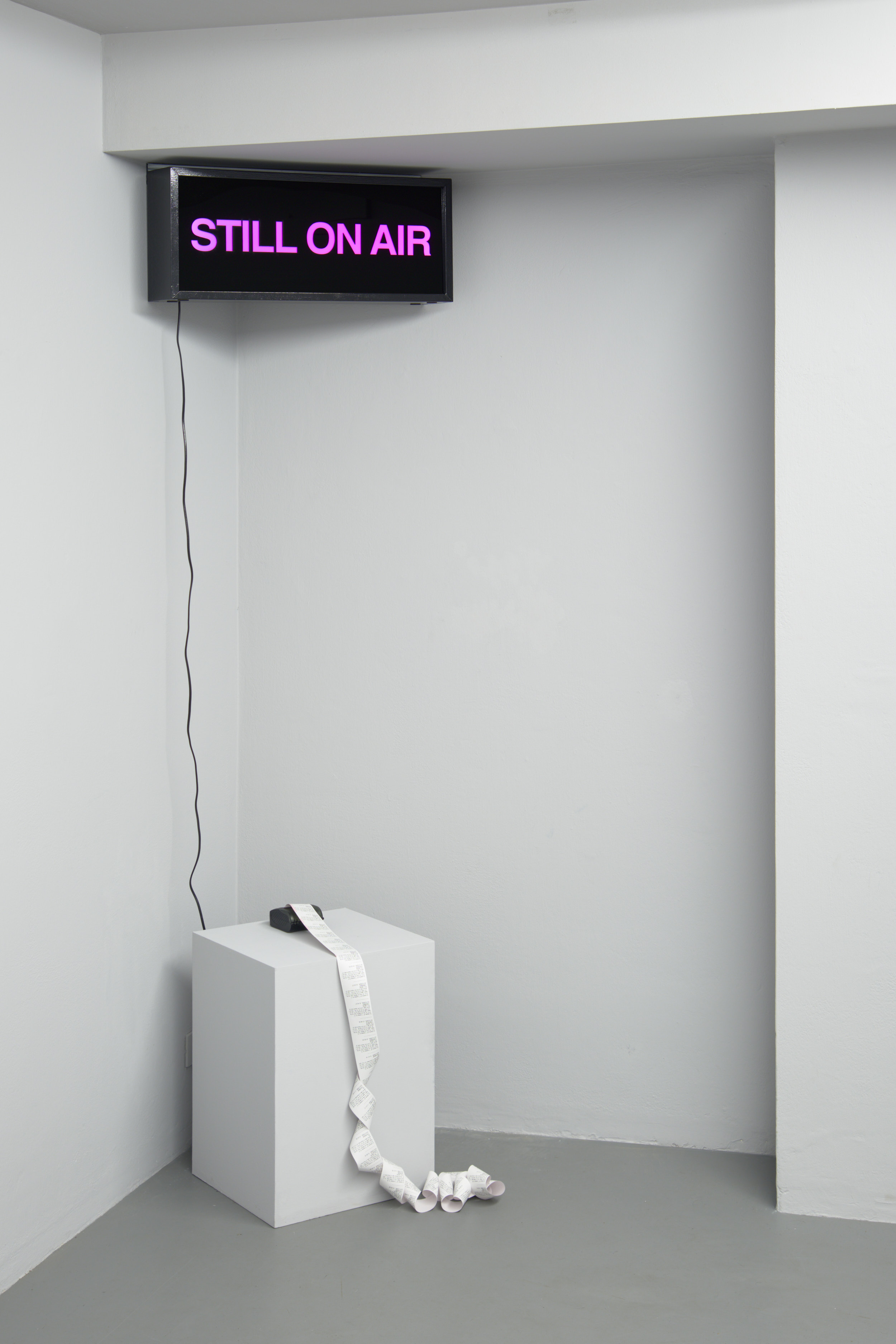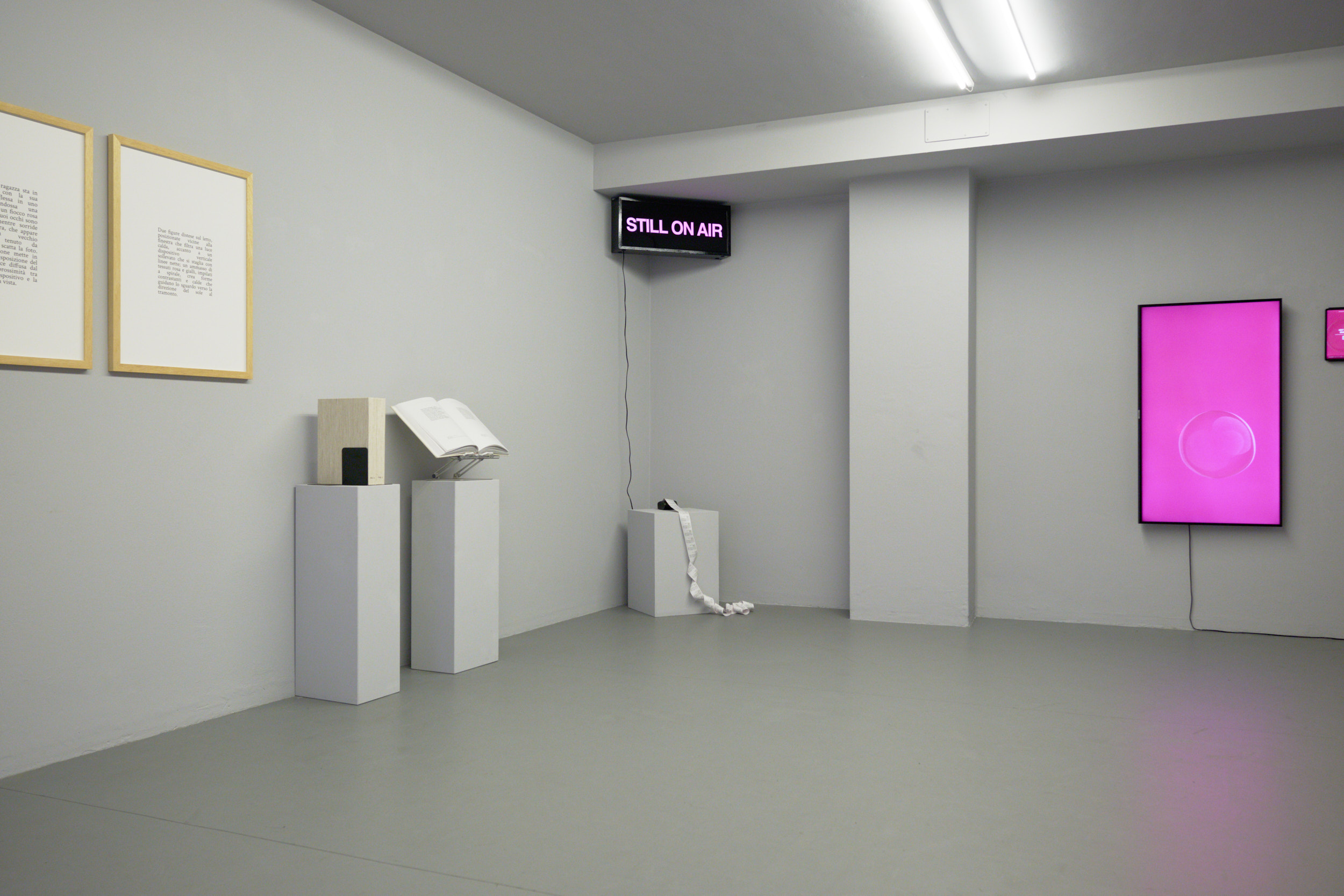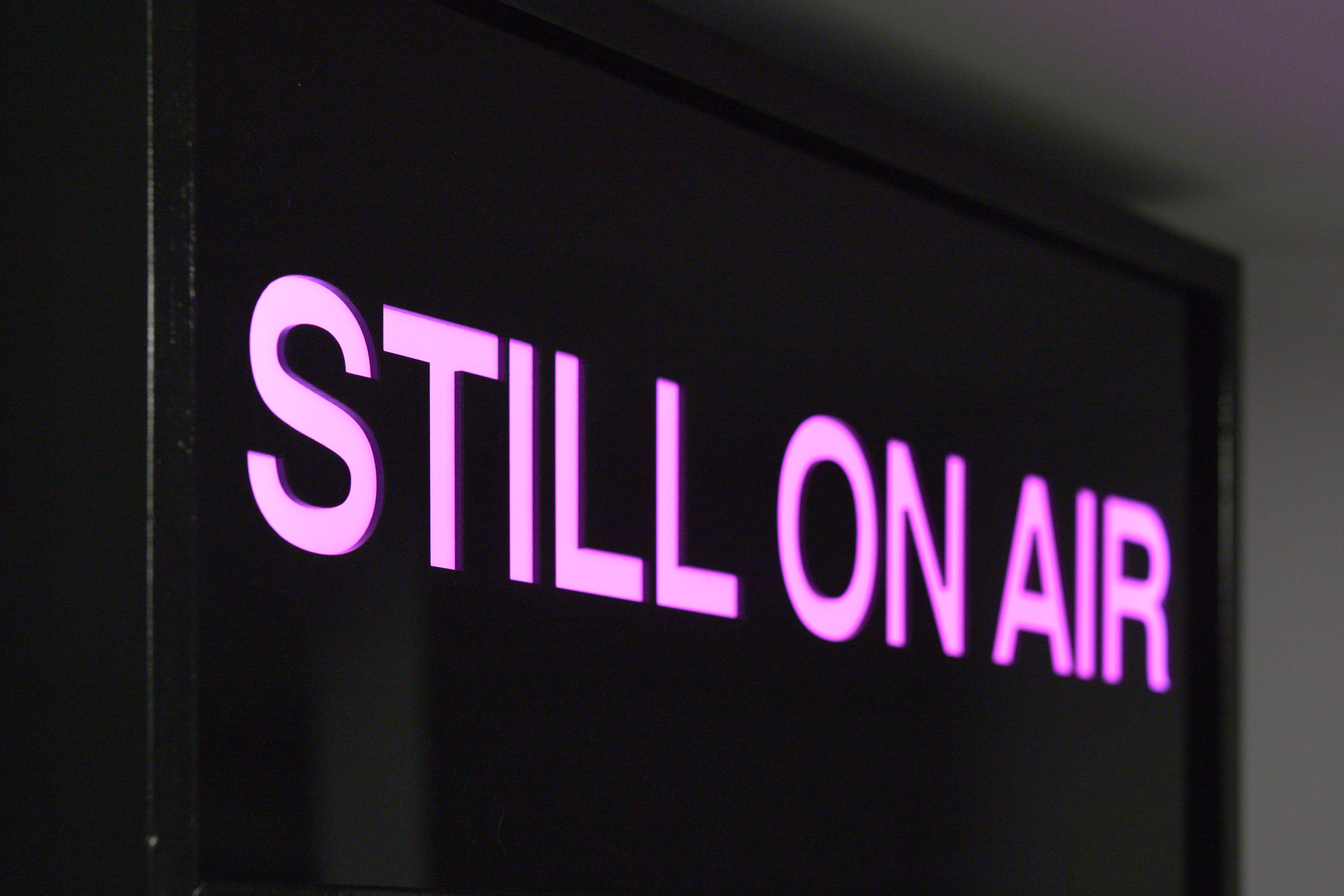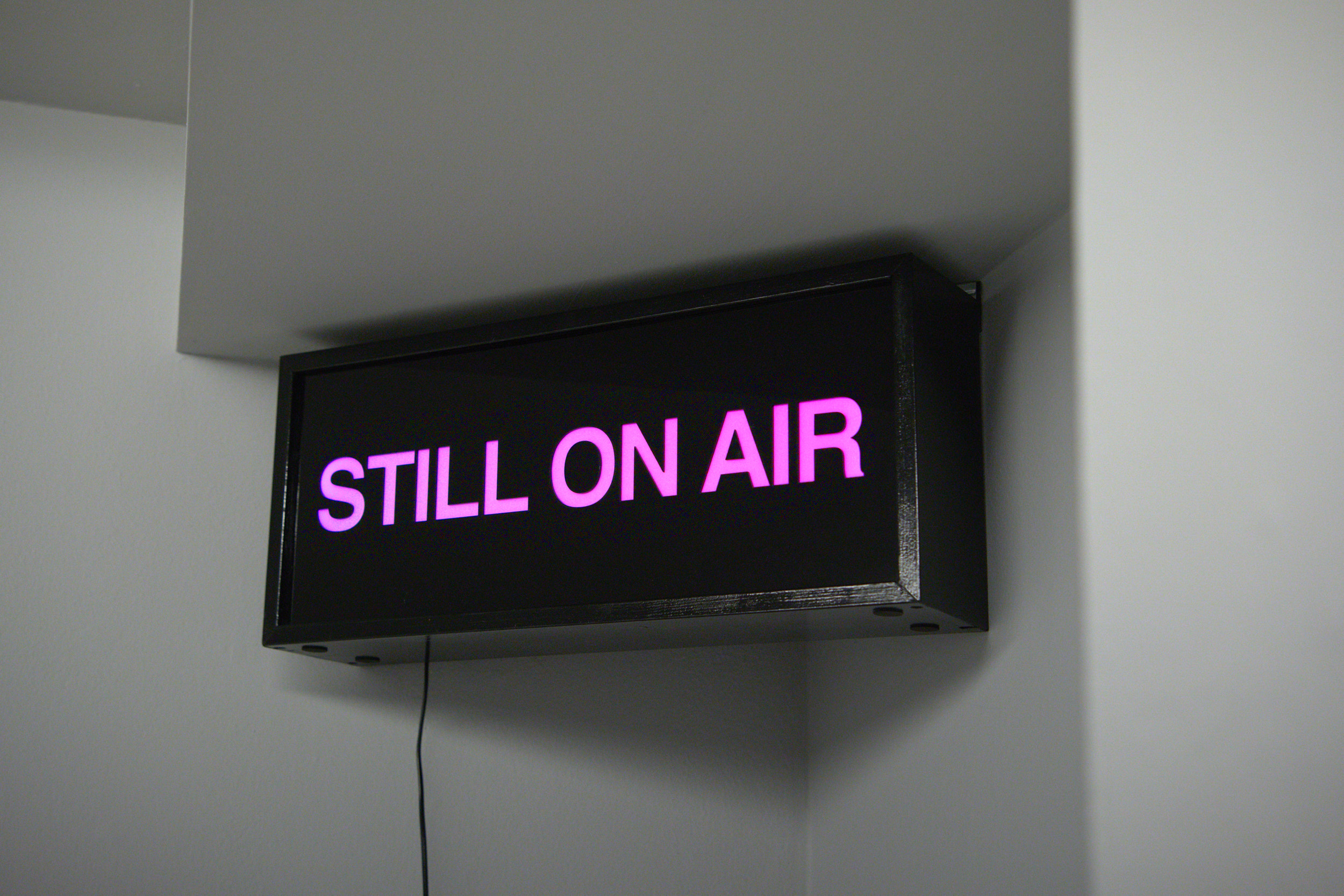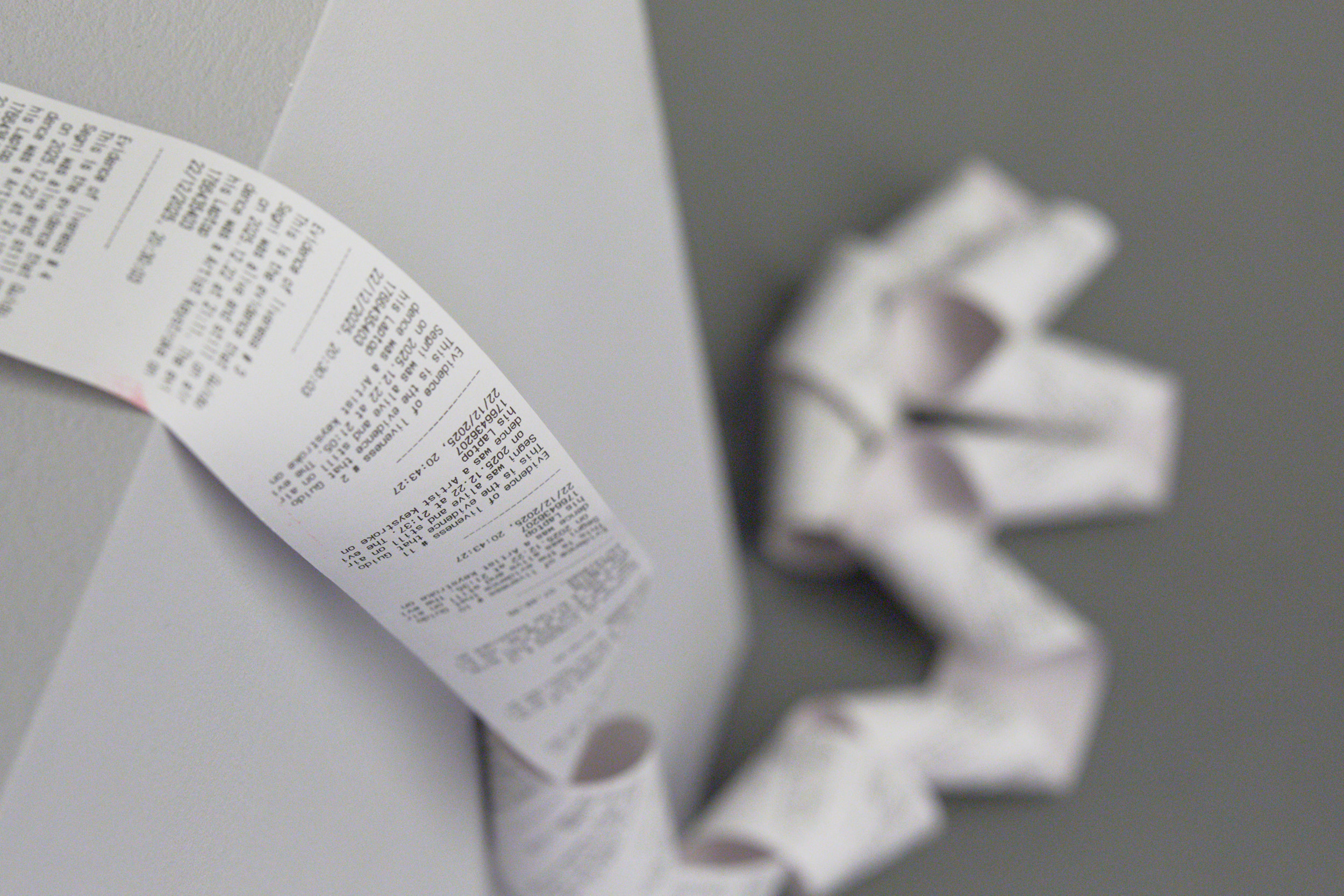
A selection of installation views from Ho fatto tardi at SMDOT, Udine.
The exhibition includes works from the post-hype NFT trilogy, including EvidenceOfLiveness.sol and Still on Air.
Curatorial text by Stefano Monti
But I’m Here
SMDOT/Contemporary Art is delighted to finally present the new solo exhibition by the artist Guido Segni, entitled HO FATTO TARDI. The artist himself makes clear that the title is not a poetic or provocative statement: it is a simple, almost technical observation. It concerns time that isn’t on time, postponed, delayed, perhaps lost, in the completion of a series of never before seen works that were started between 2020 and the end of 2025. This time interval is significant: it coincides with the conclusion of his five-year project dedicated to laziness, Demand full laziness (2018–2023), but, above all, with the widespread and persistent wave of digital fatigue that exploded during the pandemic. Lockdown, forced hyper-connection and continuous exposure to screens brought about a short circuit between tools and desire, between what was possible and what we wanted. Some things continued to get made at that time, but with no urgency or destination, leaving materials and ideas to settle in a condition of suspension, inside a series of folders on his computer desktop. The silent, tiring, accumulation of these works and their being only formalised now, neither in the dimension of “hype” nor “in time”, is not an act of nostalgia or a criticism of the speed of technological innovation, rather, it establishes a physical and conceptual environment capable of producing a fruitful reflection about the friction between the biological body and the technological body.
In the contemporary debate about the relationship between human beings and technology, the body emerges as the main terrain for negotiation and conflict. As Maurice Merleau Ponty showed in Phenomenology of Perception, the body is not any object, but the ‘body unto itself’, a transcendental condition of experience and meaning. The biological body is therefore a lived body, a vulnerable and situated body, which gets to know the world through its own sensitive exposure and finiteness. In stark contrast, the technological body, consisting of prostheses, digital devices and algorithmic systems, responds to a technical rationality oriented towards efficiency, replicability and the overcoming of organic limits. However, as Gilbert Simondon argued, technology cannot be thought of as a mere tool, external to the human: it participates in the processes of individuation and continually redefines the relationship between subject and environment. In this perspective, the technological body does not erase the biological body, but enters with it into an unstable and problematic relationship. Donna Haraway, in A Cyborg Manifesto, has radicalised this intuition by showing how contemporary identity is already a hybrid, riven with porous boundaries between organism and machine. Bernard Stiegler interpreted the technology as a form of “externalisation” of memory and cognitive functions, capable of both enhancing and impoverishing the human experience. It is in this theoretical scenario that the relationship between biological body and technological body can be understood not as a harmonic synthesis, but as a field in permanent tension. Rather, it is configured as a relationship in which the resistance of the embodied body prevents technical rationality from imposing itself as the total horizon of human experience. Far from being a mere obstacle, friction thus proves itself to be an essential condition: it introduces measure, limit and reflexivity into a system that would otherwise be oriented towards limitlessness and automation. In this continuous friction, the body reaffirms its finiteness as a value, opposing the logic of optimisation with a logic of lived experience. Accepting friction does not mean giving up technology, but recognizing that it is precisely in resistance, error, slowness and fatigue that the space of the human being is preserved. Friction then becomes the place where technology can be critically inhabited, not suffered, and where the body, instead of being overcome, returns to being the starting point for a more conscious relationship with the technological world. The friction between the biological body and the technological body finds one of its most lucid expressions in the activity of contemporary artists, who frequently work in the space of friction between the embodied gesture and the technical apparatus. Unlike other areas, where technology is oriented towards functional transparency and the reduction of error, artistic practice often exposes, amplifies and displays precisely the things that do not work, that resist or exceed. The body of the artist and the spectator thus becomes the place where technology is not limited to performing, but is interrogated, slowed down, and sometimes sabotaged. In this sense, art does not eliminate friction, but takes it as an operational material, transforming it into a sensitive and critical experience.
Guido Segni transforms friction into form, making visible the things that remain obscured or naturalised in everyday life. His exhibition and artworks become a privileged dimension where the conflict between the biological body and the technological body is not resolved, but made thinkable, experienceable and shareable.
The friction between the biological body and the technological one is therefore not an accident to be corrected, but a structural condition of contemporary experience. It is precisely in friction that the body manifests its irreducibility to the logic of optimization, opposing the abstract time of technology with a time that is experienced, qualitative and embodied. The expression “I am late …but I’m here”, the title of the exhibition and of this text, used separately and improperly by the undersigned, effectively summarises this condition: the delay signals the friction with a system that demands synchrony and performance, while the “but” opens a space of presence that does not coincide with punctuality, but with experience. In this gap, the difference becomes visible between the technological body, which is always aligned or else becomes dysfunctional, and the biological body, which is capable of arriving late and yet still being there. This brings with it a temporal density that cannot be reduced to a calculation.
The viewer is thus confronted with a great array of devices and presences: a television monitor that shows an NFT bubble connected to a lottery, offering the possibility of buying and owning the risk; a light box that signals the artist’s online presence; Fine Art inkjet prints and catalogues/registried that describe and transfigure all the images stored in his computer; a vacuum cleaner that moves around the gallery space, stumbling, changing direction and claiming its emancipation by “writing” its thoughts on another monitor; the live, figurative sound of the artist’s heartbeat invades the exhibition space almost as if to suggest a shared rhythm, and lastly , with a Duchampian touch, his cushion is displayed in a case that, through a captcha bearing the writing “Tired”, becomes a manifesto and testimony to a declaredly “reflexive” tiredness. The artistic practice exhibited here shows how such friction can become fruitful. By inhabiting delay, slowness, error and fatigue, art transforms the resistance of the body into form, making time a material and not a constraint. In this sense, friction does not mark the limit of technology, but the very place where it can be critically thought about and re-appropriated by human experience. Accepting friction means recognizing that it is precisely in this friction, suspension and “being late” that a space of freedom, reflection and creation is preserved: a space in which the body continues to constitute a necessary human counterpoint, instead of being overcome by technology.
Stefano Monti